
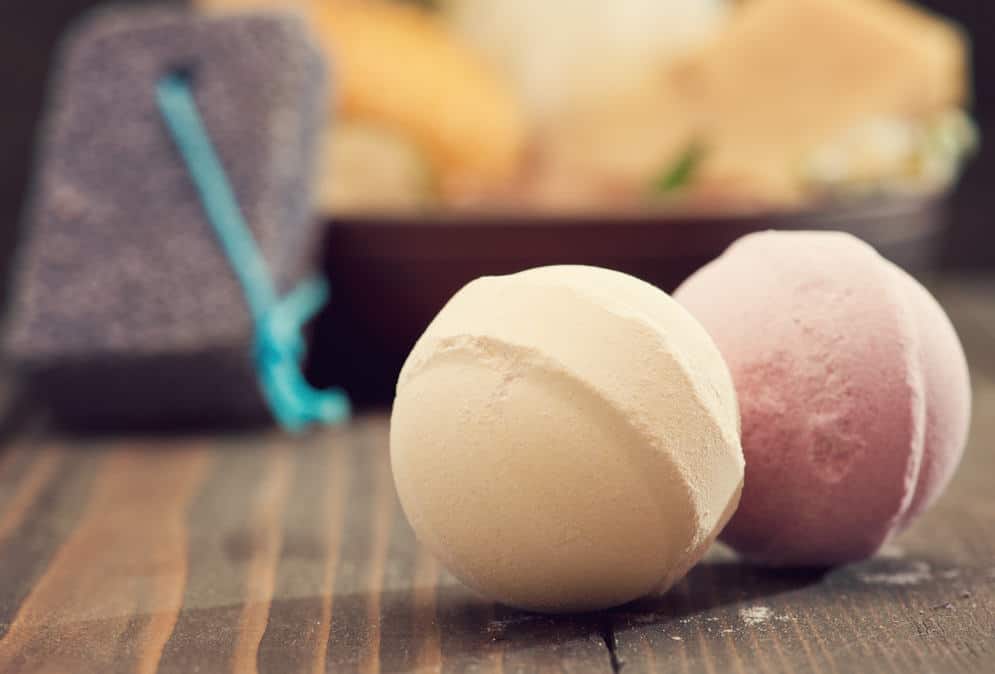
Tanning Bath Bombs – Do They Exist?
How Do Regular Bath Bombs Work?
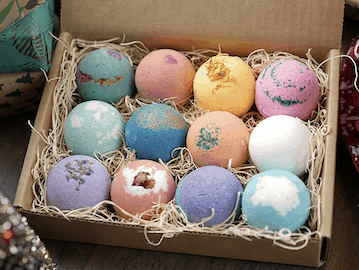
By the way, these are my favorite (non-tanning) bath bombs that you can pick up on Amazon; they are seriously amazing.
They can contain pretty much anything you can think of. Some bath bombs contain colorants, giving your bath a colorful tint, while others are plain, simply containing fragrance and oils.
Bath bombs dissolve and fizz in the bath, releasing essential oils, nourishing butters, and other additives, such as glitter or petals.
They are made with sodium bicarbonate and citric acid.
As dry ingredients, they are inert, but once combined with water in the bath, they undergo a chemical reaction; the citric acid reacts with the sodium bicarbonate, producing sodium citrate and carbon dioxide.
This carbon dioxide bubbles and gases the bath. As this happens, the oils and fragrances are released into the bath water.
The fizzing and bubbling don’t last long, but it is an experience loved by many who just want to have a relaxing bath with lasting fragrances.
How Would Self-Tanning Bath Bombs Work?
The theory behind self-tanning bath bombs is that along with the sodium bicarbonate and citric acid, there would be added self-tanning agents.
DHA is used in self-tanning products; this ingredient reacts with dead skin and forms a tan.
Ideally, the DHA would be added to the bath bomb, and when it fizzles and dissolves in the bath, the DHA would evenly cover the body in the bath water, giving you a tan.
However, the DHA dilutes in water and would effectively have no impact on your body. Another ingredient, in addition to DHA, would be needed to tan the skin.
There isn’t really another option on the market, so this is where self-tanning bath bombs hit a wall.
Finding an ingredient that would tan the skin without dissolving in water has been the battle in creating these self-tanning bath bombs.
Adding pigments could be an option, but a brown pigment would leave you looking super weird, and an orange pigment would leave you looking like, well, an orange.
To date, there has been no progress in identifying the extra ingredient, but many are seeking a solution.
How Effective Would They Be?

Self-tanning bath bombs seem like a great idea at first. The tanning agent would cover your body evenly while you bathe, making it a super easy and relaxing way to tan as well.
You don’t have to sit in the hot sun, and you don’t have to worry about applying self-tanning lotion or mousse evenly, usually ending up patchy and streaky.
How convenient would it be to just soak away all your worries and soak up a tan at the same time?
On the other hand, though, think about how you lie in a bath. You don’t submerge your face underwater while you bathe, and your feet and shoulders usually stick out as well.
That leaves pieces of your body that won’t be underwater and evenly tanned, while other parts of your body are.
This kind of defeats the whole idea of the bath bomb giving you an even tan all over your body.
Who wants a tan tummy, thighs, and arms, but a pale face, neck, shoulders, and feet? It can’t really be a significant market for that.
Why Would You Use a Tanning Bath Bomb?
For most people, convenience is a key factor.
Finding a way to accomplish something with the least amount of effort and time is a goal that everyone strives for, whether you call it laziness or effective time management.
Being able to clean yourself, have a bit of a soak in the tub, and tan is almost like a dream come true. Not worrying about the technical aspects, just the basic idea seems great.
Bath bombs also contain ingredients and additives that moisturize and soothe the skin.
Combining this with self-tanning also helps nourish your skin, while saving you from having to put in extra effort to moisturize your skin after applying self-tanner.
You would have to prepare your skin in the same way for a self-tanning bath bomb, if they existed.
Exfoliating and hydrating prior to application will allow the tanning agent (whatever it might be) to apply to your skin properly, and getting rid of excess dead skin will leave you with a tan that is even and natural-looking, not patchy and streaky.
The dead skin cells attract a stronger reaction from the self-tanning DHA, so the more dead skin cells in one area, the more intense the reaction and the darker the tan will be.
This is why people often end up with darker knees and elbows when self-tanning, as these areas are often dry and have a higher concentration of dead skin cells.
Probably most importantly to most people, the self-tanning bath bombs would probably be fairly cheap.
The core ingredients are everyday household items that are inexpensive to purchase, so theoretically, this should mean that the self-tanning bath bombs would also be affordable.
They would only become pricey if expensive oils and fragrances were added to the formulation.
Alternatives for Now
Luckily, until these magical and mystical self-tanning bath bombs are actually created — if they are created — there are some really good and effective alternatives for you to use for self-tanning.
The products are easily purchased online, and if you get stuck with the application, there are always helpful tips and tricks from others who have used them before.
Here are some alternative products you can try while you wait for self-tanning bath bombs to be created:
Spray tan – Spray tanning has come a long way from the days of dark orange people walking around with slicked-back hair and teeny-tiny bikinis.
There are many professional salons with highly knowledgeable spray-tan applicators who truly understand their craft.
There are amazingly natural-looking spray-tan products that sit lightly on your skin and don’t feel heavy or cloggy.
A spray tan from a salon can be quite expensive, but you would rather have it done properly and by someone who actually knows what they are doing, rather than getting it done at a cheap back-alley salon and ending up with a new shade of orange.
Self-tanner – There are countless self-tanning products on the market (this one is my favorite by far). There are lotions, mousses, wipes, and even self-tanning soap.
This method of tanning is so popular because it can be done at home, whenever you want.

You can control the darkness of your tan by adjusting how often you apply the self-tanner and the amount you use.
Self-tanner is also relatively inexpensive, but it’s essential to purchase a high-quality product. Anything sub-standard and you will end up with a funny, patchy orange tan that won’t last long at all.
Tanning pills – While the old-fashioned tanning pills aren’t the safest to use, there are tanning pills that act as accelerators.
They contain ingredients that promote the production of melanin in the skin (responsible for the browning of the skin under UV rays) and ingredients that increase the skin’s sensitivity to light.
These pills help you cut down the amount of time you need to spend in the sun to get a natural tan, but at the same time, they still require you to be in the sun, which is always damaging and harmful for your skin, both in the short term and the long term.
Self-Tanning Bath Bombs
the browning of the skin under UV rays) and ingredients that increase the skin’s sensitivity to light.
These pills help you cut down the amount of time you need to spend in the sun to get a natural tan, but at the same time, they still require you to be in the sun, which is always damaging and harmful for your skin, both in the short term and the long term.
Self-Tanning Bath Bombs
Yes, self-tanning bath bombs do sound incredible, but there are a few catches that don’t really speak to their practicality.
In the meantime, however, there are other great ways to get a natural-looking tan at home, some of which don’t even involve setting foot in the sun.
For now, stick to regular bath bombs and a good self-tanning lotion.
You will still be able to soak up all that fizzy goodness in the bath with essential oils and wonderful fragrances, and then achieve a summer goddess tan with a good self-tanning lotion.


