5 Best Self-Tanning Products For Psoriasis
Can you use self-tanner if you have psoriasis? Some people may tolerate it on calm, intact skin, but no self-tanner is suitable for everyone with psoriasis. Avoid applying it to inflamed, cracked, bleeding, or sore areas, and ask your dermatologist before trying it if your skin is actively flaring.
A smooth tan is a nice extra, but comfortable skin comes first. Scaly patches may take on colour differently, so self-tanner can make plaques more noticeable rather than conceal them.
It is reasonable to worry about dryness or irritation. Fragrance, other ingredients, and friction during application can all matter, even when a product is marketed for sensitive skin.
A moisturising formula is not a psoriasis treatment. Start with a product’s full ingredient list and your own sensitivities. Words such as “natural,” “organic,” or “streak-free” do not tell you whether it will feel comfortable on your skin.

Sunless colour changes the appearance of your skin without deliberate UV tanning. Continue your prescribed psoriasis care and use a broad-spectrum SPF 30 or higher sunscreen outdoors; a cosmetic tan does not provide that protection.
Below, compare five lotion and mousse options, learn how to apply them gently, and find out why plaques may darken unevenly. None of these products is proven to treat psoriasis or prevent flares.
Before choosing a formula, decide whether your skin is ready for a cosmetic product:
Medical information: Goodlookingtan.com provides general beauty information, not medical advice, diagnosis, or treatment.
If your psoriasis is active or you are unsure which areas are suitable, your dermatologist can help you decide whether to try self-tanner now or wait.
Do not stop or change prescribed treatment to make a tan last longer. Ask your clinician about timing cosmetics around medicated creams or supervised light therapy.
If a product causes burning, itching, or a rash, stop using it and gently wash it off. Seek medical advice if symptoms persist or your psoriasis worsens.
Planning colour for an event? Leave time for a small-area test and for the shade to develop. Trying a new formula immediately before getting dressed leaves little room to assess the result.
What is Psoriasis?
Psoriasis is an immune-mediated condition. It causes skin cells to build up more quickly than usual, often forming raised, scaly patches. The American Academy of Dermatology explains the role of the immune system in this process.
Plaques can feel itchy, tight, or painful. Their colour varies with skin tone, and they are not always bright red. Texture and tenderness matter when deciding whether an area should be left alone.
Psoriasis is often long-term, with periods when symptoms are more or less active. Treatment can help manage it, but a cosmetic tan cannot address the underlying inflammation.
Triggers differ from person to person. Rather than assuming every new product is safe, pay attention to what your own skin has reacted to before.
The AAD’s guide to psoriasis triggers covers factors such as skin injury, stress, infections, and dry weather. Irritating skin preparation is particularly relevant when planning a tan.
Keep treatment consistent. If your clinician has prescribed something to manage scale, follow those directions rather than adding an extra exfoliating step for tanning.
Self-tanner may add warmth to unaffected skin, but it does not reliably hide psoriasis. Raised texture remains visible, and extra colour on scaly areas can increase contrast.
How Does Psoriasis Affect Self-tanning?
Dry or inflamed plaques are a poor starting point for tanning. Leave actively irritated areas untanned instead of trying to coat them evenly with more product.
Even a product tolerated elsewhere on your body may sting on an irritated patch. A small-area test helps assess tolerance, but it cannot guarantee that a later application will not cause a reaction.
Start with a light shade and one thin application on suitable skin. Deepening the surrounding tan can make an untanned plaque stand out, so check the overall result before layering more.
Colour can also fade unevenly as surface skin sheds. That is a cosmetic limitation, not a sign that you should scrub plaques or apply extra tanner to them.
Most developing self-tanners use dihydroxyacetone, or DHA. As the FDA explains, DHA changes colour by reacting with amino acids at the skin surface.
For example, a dry elbow patch may look darker than the skin around it, then lighter as scale sheds. Adding more product to that patch will not reliably balance the colour.
No formula can guarantee that plaques will blend in. If covering colour differences is your main goal, ask your dermatologist whether a tolerated wash-off body makeup would be a better option for intact skin.
Check fragrance and known triggers first. If scented skincare has caused reactions before, look for a clearly fragrance-free formula. Added aloe, oils, or vitamins do not cancel out an ingredient you cannot tolerate.
How To Prep Skin With Psoriasis For Self-Tanning
Prepare gently, without trying to remove every scale. Wait until your skin is calm and intact, and keep following your usual psoriasis care. Postpone tanning if an area is sore or actively irritated.
Exfoliation: Our guide to exfoliating before self-tanning covers general tanning preparation, but psoriasis needs extra caution. The AAD advises gentle washing and avoiding scrubs, loofahs, and washcloths. Do not pick or buff plaques to create a smoother tanning surface.

Moisturise: Keeping your skin moisturised can help with dryness, but it does not guarantee even tanning. Use a fragrance-free moisturiser you already tolerate, and let it absorb before applying tanner to suitable areas according to the bottle.
Do not treat a thick barrier cream as permission to tan over an active plaque. Keep medicated creams separate from the tanning product, and ask your clinician how to time them if they are used on the same area.
On ordinary dry joints without active psoriasis, a little plain moisturiser may help reduce excess colour if the tanning instructions allow it. Avoid a heavy all-over layer immediately before tanning, which may change how the product spreads.
Test first and apply lightly. Follow the product’s skin-test instructions on a small area of unaffected skin, including the waiting period. Use clean hands or a clean, soft mitt with gentle pressure. Avoid the eye area and lips, wash your hands afterwards, and wait for full development before adding colour.
5 Self-Tanners To Compare If You Have Psoriasis
Choosing a self-tanner with psoriasis is more about tolerance than brand popularity. Start with the current ingredient list and your history of reactions.
Lotion or mousse? A gradual lotion builds colour over several applications. A developing mousse usually involves one application followed by a timed rinse. Choose the routine your skin and schedule can tolerate, rather than assuming either texture is inherently gentler.
Use this checklist to compare the options:
- Current ingredients and fragrance
- Your known sensitivities
- Application and development time
- Cost per application
- Clear labelling and directions
Several options below contain fragrance. If that is a known trigger, a verified fragrance-free alternative may be a better starting point than choosing by ranking. Check the bottle you receive, as ingredients and directions can change.
1. Vichy Capital Idéal Soleil Moisturising Self Tanner Milk

Vichy Capital Idéal Soleil Moisturising Self Tanner Milk offers a lotion format for adding colour without UV tanning. The manufacturer describes it as tested on sensitive skin, but that is not the same as evidence that it suits psoriasis.
The manufacturer’s ingredient list includes glycerin, shea butter, and vitamin E, alongside fragrance and alcohol denat. Check your bottle, especially if those latter ingredients have irritated your skin before.
Best suited to: someone who prefers a moisturising lotion and already tolerates similar ingredients on unaffected skin. Main drawback: the fragrance and alcohol denat. may be unsuitable for readers who have reacted to them before.
Colour can be built with repeat applications, but uneven texture may still show. Assess the finished shade before applying more, rather than expecting a gradual product to prevent every streak.
The manufacturer lists use 2 to 4 times weekly depending on the desired result. Follow your bottle, assess the developed colour between applications, and pause if skin becomes irritated.
2. Bondi Sands Everyday Gradual Tanning Milk

Bondi Sands Everyday Gradual Tanning Milk is a body lotion for building subtle colour over repeated applications. Its gradual format can make it easier to stop when you reach the shade you want.
The current US ingredient list includes aloe, shea butter, and vitamin E. It also contains fragrance, so those moisturising ingredients do not make it a fragrance-free choice.
The brand’s directions and warnings describe clean, dry skin, even application, and washing hands afterwards. The brand says colour may become noticeable after 1 to 3 applications, but warns against use on damaged or inflamed skin.
Best suited to: someone who wants subtle, buildable body colour and tolerates scented lotion. Main drawback: repeated application means repeated contact with the formula. Follow the label’s test instructions and avoid active plaques.
3. Coco & Eve Sunny Honey Bali Bronzing Self Tanner Mousse

Coco & Eve Sunny Honey Bali Bronzing Self Tanner Mousse offers a developing mousse rather than a daily tanning lotion. Its naturally derived DHA claim describes the tanning ingredient’s source, not a psoriasis benefit.
Best suited to: someone who prefers a developing mousse to repeated lotion applications and tolerates the full formula on unaffected skin.
Its guide colour can help you see where the mousse has been applied. Use a light touch with a soft mitt rather than repeatedly rubbing over one area to make the tint look perfectly even.
The brand’s Sunny Honey ingredient lists include glycerin, fruit extracts, and fragrance. Read the list for your chosen shade rather than relying on an older ingredient description.
Guide colour is temporary application tint, not the final tan. Some washes away at the directed rinse, so assess the developed shade before deciding that you need another coat.
Main limitation: the scented formula may be unsuitable if fragrance is a known trigger for you. A pleasant-smelling product can still irritate sensitive skin.
Follow your bottle’s development and rinse times. Reapply only when your skin is comfortable, and let uneven old colour fade rather than exfoliating plaques to keep a fixed tanning schedule.
4. Miami Gorgeous Self-Tanning Mousse
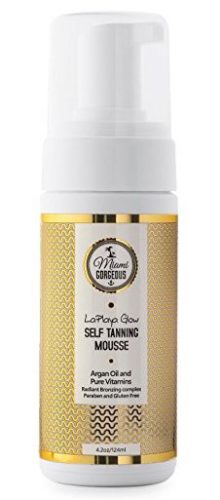
Miami Gorgeous Self-Tanning Mousse is a developing mousse for readers who prefer a light application texture. The brand currently presents it as LaPlaya Glow; check that the seller’s version and label match what you intend to buy.
A clean, soft mitt can make it easier to spread mousse without staining your palms. It is an application tool, not an exfoliator: avoid pressing or buffing over scaly skin.
The brand’s product page describes argan, olive, and jojoba oils, but does not provide a complete ingredient list in its product description. Main drawback: obtain the full list, including any fragrance, before buying if you have sensitivities. The highlighted oils alone cannot establish suitability for psoriasis.
5. Thermalabs Sunless Tan

Thermalabs Golden Standard Self Tanner is a lotion option, but a purchase depends on verifying the exact product. “Natural” and “organic” descriptions do not show whether the current formula will suit your skin.
Before considering it, obtain the current ingredient list and application warnings from the seller or manufacturer. Do not assume an older description establishes the current formula, development time, or suitability for reactive skin.
Main drawback: unclear current labelling makes it harder to compare with products that publish full ingredients. If the seller cannot supply the label and directions, choose a better-documented option before testing anything on your skin.
How To Maintain A Tan With Psoriasis
Maintain skin comfort before maintaining colour. Keep up your usual moisturising routine and prescribed treatment, even if that means the tan fades sooner.
For everyday psoriasis care, the AAD recommends gently applying a fragrance-free moisturiser after bathing. A cream or ointment can be useful for dry skin; use the texture your skin tolerates.
You may notice uneven fading around scaly areas. Frequent exfoliation is not required to maintain a tan with psoriasis, and rubbing off scale can irritate your skin.
Before reapplying, check both your skin and the remaining colour. Pause if there is irritation. If the tan is patchy, let it fade rather than adding a full new layer that may deepen the darker sections.
Cleanse gently with warm water and a mild cleanser, then pat dry. Skip abrasive tan-removal mitts, strong scrubs, and prolonged hot soaking; let stubborn colour fade naturally.
Can you use a tan remover? Be cautious with products that rely on exfoliation or vigorous rubbing. Developed colour fades as surface skin sheds, so you do not need to scrub it away simply to prepare for your next application.
Final Thoughts
Self-tanner may be an option on calm, intact skin, but it is not a way to treat or reliably conceal psoriasis. A light application and realistic expectations are more useful than trying to force a perfectly even finish over plaques.
If you are receiving prescribed phototherapy, ask your treatment team before adding self-tanner. Supervised light treatment has a different purpose from cosmetic tanning; do not replace it with tanning-bed sessions. Keep following your team’s instructions for cosmetics and outdoor sun protection.
Choose with your known sensitivities in mind, test as directed, and stop if irritation appears. Natural ingredients are not a guarantee of safety, and postponing a tan during a flare is a sensible beauty choice.