

5 Best Self-Tanners For Eczema
The short answer: start with the St. Moriz Professional 1 Day Instant Tan. It is body makeup rather than a self-tanner, so there is no DHA reacting with your skin and the whole thing washes off in the shower that night. If you want color that lasts, the Beauty by Earth Self Tanner uses sugar-cane-derived DHA in an ingredient list that is mostly aloe, shea butter and coconut oil.
While you might be desperate to get a sunless summer glow, you might be worried that self-tanner could make your skin condition worse or highlight the affected areas.
Depending on how severe your eczema is, you can use self-tanner to achieve a wonderful tone. However, you need to be aware of the ingredients in the self-tanner you want to use.
Most self-tanners contain DHA (dihydroxyacetone), a coloring agent that reacts with the outer layer of dead skin and stains the skin.
While DHA helps to achieve a sunless tan, it can be very drying to the skin and can even cause dehydration.
For those with eczema, it is better to opt for a self-tanner that contains no DHA to avoid drying out the skin even further.
So, if you have eczema, you want to look for self-tanning products that either don’t contain DHA, contain less DHA, or at least contain a natural derivation of DHA.
Alright, let’s get right into it.
5 Best Self-Tanners for People With Eczema
Below is my carefully curated list of the best self-tanners for eczema. Read each review carefully to make sure you know exactly what is in each product to protect your skin.
1. St. Moriz Professional 1 Day Instant Tan

This one is body makeup rather than a self-tanner, and that difference is the whole reason it sits at the top of an eczema list. The color goes on the surface of your skin and comes off in the shower the same day.
There is no DHA doing the work here. Nothing reacts with your dead skin cells, and nothing pulls moisture out of the patches you are trying to protect. You get the color for one evening and your skin gets nothing to recover from.
It goes on in a medium shade and dries fast. Once it has set it is transfer resistant and splash proof, so a warm evening or a surprise rain shower won’t leave it on your clothes.
Aloe vera and vitamin E are in the formula to keep things hydrated while you wear it, and the tube is vegan.
Removal is soap and warm water. No scrubbing at old tan, no patchy fade over four days – which is usually the part that makes self-tanner miserable on eczema-prone skin.
It rates 4.4 stars across 913 reviews, which is unusually strong for a one-day wash-off tan.
2. Beauty by Earth Self Tanner

If you would rather have color that lasts a few days, this is the gentlest way I would go about it. The DHA is derived from sugar cane, which is the third option described above – you are not avoiding DHA altogether, but you are not putting a synthetic one on inflamed skin either.
The rest of the ingredient list reads like a moisturizer: aloe vera leaf juice, shea butter, coconut oil, jojoba and argan oils, green tea, pomegranate and witch hazel extracts. It is dye free, dermatologist tested and made in the USA.
It also builds. One coat gives a light color and you go again the next day if you want more, which is a far safer way to work on skin that goes blotchy the moment you overdo it.
Streak-free is the claim, and 4.2 stars across more than 23,000 reviews back it up. It is the best-selling body self-tanner on Amazon.
Patch test anyway. DHA of any origin can sting broken skin, so try a small area on the inside of your arm and give it a day before you commit to your legs.
3. Jergens Natural Glow Wet Skin Moisturizer
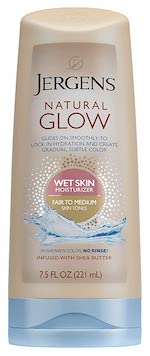
Many people (including myself) really enjoy the Jergens Natural Glow Gradual Daily Moisturizer, but this one is special because it can be applied to wet skin!
Applying self-tanners with a mitt on dry skin can be uncomfortable for people with dry skin. The skin can flake, and streaky patches can appear.
With this formula, you can apply the lotion with your hands after turning off the water after a shower.
Let yourself drip dry and pull your hair up so no water droplets run down your back during application.
Simply rub the lotion all over and dry yourself off with a towel. The lotion is color-free, so it won’t transfer onto your towel.
Since this is a gradual bronzer, you will want to reapply after every shower for up to a week to start seeing results, but it is worth the wait!
4. Ed Hardy Butter Me Brown DHA-Free Bronzing Lotion
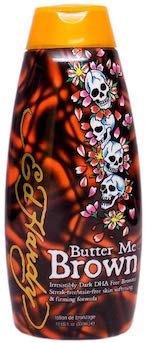
This Ed Hardy bronzer is completely DHA-free but still helps you to build a wonderfully bronzed tan.
What makes it an ideal self-tanner for those who suffer from eczema? Macadamia nut and sweet almond oils, the two main oils in this formula, are known for their great skincare properties.
The MelanoBronze formula stimulates melanin activity while allowing for a natural glow.
The natural extracts give you an ultra-bronzed tone while caring for your skin and keeping it beautifully hydrated.
It has a brown sugar scent, so be prepared for that, but otherwise, it is a gentle formula.
5. Bondi Sands Self Tanning Foam
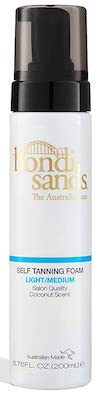
This Bondi Sands Self-Tanning Foam is one of the best self-tanners for eczema. It offers one of the most even bronzing effects.
It does a great job at minimizing discoloration between normal skin and eczema patches. It is one of their lighter-weight formulas, so it won’t enhance any color differences.
As with any self-tanner, the secret to smooth results is in the prep work, so remember to exfoliate and prep your skin before application.
This formula does contain DHA derived from various plant sources, including beet and sugarcane.
It doesn’t state exactly how much DHA is in the bottle, so go easy at first or do a test patch before applying it everywhere.
What is Eczema?
Eczema is a skin condition in which patches become itchy, inflamed, red, cracked, and dry. Blisters may even appear on the skin.
Eczema has different stages, and many people experience varied symptoms.
Certain foods can trigger eczema, and the symptoms can vary according to the person’s age.
Environmental factors such as smoke and pollen can also trigger eczema, and certain skin treatments can make the symptoms worse.
It is important to find the right moisturizers and creams to help combat eczema and prevent its symptoms from getting worse.
Keeping skin moisturized is important, as eczema tends to dry out the skin, which results in it becoming inflamed, cracked, and rough.
Eczema is not contagious, and in some cases, it can disappear over time.
Self-Tanning with Eczema – Everything You Should Know
Sometimes, spray tans and self-tanners can cause a flare-up of eczema or can cause eczema to look inflamed or irritated.
When using a self-tanner, you want to achieve flawless, even skin, and having stained areas due to eczema is not ideal.
Certain ways to apply self-tanner help lessen the appearance of eczema and avoid irritating the affected areas further.
Gradual tanners are your best option, as they do not contain DHA or very little of it. DHA dries out the skin and can definitely cause a flare-up of eczema.
Here are some recommendations and tips when applying self-tanner to eczema-prone skin:
• Choose an organic self-tanner that contains little to no DHA. Self-tanners that have hydrating properties are also great, as they care for the skin instead of drying it out further.
• Gradual tanners work much better on skin that has eczema. Using a sponge blender, the gradual tanner can be easily applied to the face. This can be done daily until you achieve the intensity of tan that you are happy with.
• Clean the skin thoroughly before application. Once the skin has been cleaned, apply a gentle, organic moisturizer. Give it time to absorb properly before applying the self-tanner.
• Moisturize daily, or even twice daily, to keep your skin nourished and moisturized. Some self-tanners dry out the skin, so you need to combat this to avoid any flare-ups. Moisturized and nourished skin also holds a self-tan much better than dry skin, and the tan will look more natural when the skin has a healthy, radiant glow. This lotion has been a game-changer for my skin.
If you suffer from eczema, you need to take extra care of your skin. Take it as an opportunity to give your skin the extra moisture and nourishment it deserves, all while enjoying a wonderfully bronzed glow. Once you have found the product that works for you, you will be able to enjoy days of a sunless, summer glow.
Self-Tanner for Eczema
Eczema is no reason to stop you from enjoying a gorgeous tan.
While you should avoid spending time in the sun and try to tan naturally, you can use self-tanning products to give yourself a summer glow.
Choose the right product for you, one that is natural and toxin-free, and you won’t be disappointed.
You deserve to feel like a tanned, flawless goddess, and there are definitely ways to achieve this! Take care of your skin, and enjoy looking and feeling absolutely gorgeous!
Frequently Asked Questions
Can You Use Self-Tanner If You Have Eczema?
Depending on how severe your eczema is, yes. You can use self-tanner to achieve a wonderful tone, but you need to be aware of the ingredients in the product you pick.
Why Is DHA A Problem For Eczema-Prone Skin?
Most self-tanners contain DHA (dihydroxyacetone), a coloring agent that reacts with the outer layer of dead skin and stains it. DHA can be very drying to the skin and can even cause dehydration, which is the last thing eczema needs.
What Should You Look For In A Self-Tanner If You Have Eczema?
Look for products that either do not contain DHA, contain less DHA, or at least contain a natural derivation of DHA. Hydrating formulas help too, because they care for the skin instead of drying it out further.
Are Gradual Tanners Better For Eczema?
Gradual tanners are your best option, as they do not contain DHA or very little of it. They also work better on skin that has eczema, and you can build the color up daily until you reach the intensity you are happy with.
Can Self-Tanner Cause An Eczema Flare-Up?
Sometimes. Spray tans and self-tanners can cause a flare-up of eczema, or can make it look inflamed and irritated, so how you apply the product matters as much as which one you choose.
Related Articles
Tanning Bed Rash On Buttocks (How To Treat It And Prevent It)


