

5 Best Self-Tanners For Your Legs
A smooth, even self-tan can give your legs a warm, bronzed look without relying on intentional sun exposure.
Self-tanning your legs can add temporary color and definition. Careful blending around the knees, ankles, and feet is what makes the result look polished rather than patchy.
How do you apply self-tanner to your legs evenly? This guide covers prep, application technique, product choice, and maintenance.
A good result starts with choosing a formula that is easy to spread and suits how much control you want over the final color.
Are some self-tanners better than others for legs?
Yes. Legs have several tricky areas, especially knees, ankles, heels, and feet. A gradual or easy-to-blend self-tanner can make those areas easier to control because you can build color slowly instead of trying to perfect a deep tan in one application.
Find out how to prepare and tan your legs evenly, which product formats are easiest to control, and how to keep the color looking smooth as it fades.
How to Prepare Your Legs for Self-Tanner
Good preparation helps the self-tanner spread more evenly and reduces the chance of dark, dry patches.

Skipping prep does not guarantee a bad tan, but rough, flaky, or irritated skin can make the color develop unevenly.
Here is a simple way to prepare your legs before applying self-tanner.
Shave or wax
Shave or wax before self-tanning rather than immediately afterward. Hair itself does not stop self-tanner from working, but hair removal after the tan develops can exfoliate some of the colored surface skin.
If shaving or waxing leaves your skin red or sensitive, give it time to settle before applying self-tanner. There is no universal 24-hour rule for every skin type and hair-removal method.
It is also better not to shave or wax immediately after applying self-tanner if you want the color to last evenly.
This can cause you to remove the outer layer of your skin, along with some of the tan! To learn more, check out my full guide on self-tanning and shaving.
Exfoliate
Gentle exfoliation can make a leg tan look more even. Focus on visibly dry areas such as knees, ankles, and heels, but avoid aggressive scrubbing that leaves the skin irritated.
Remember that DHA only reacts with the outer layer of your skin to develop the tan.
Excess dead skin cells can cause the tan to not look even and natural. Check out this guide to learn more.
Moisturize
Moisturizer can help balance very dry areas before tanning. Use a light layer on knees, ankles, heels, and other rough spots, then let it absorb before applying self-tanner.
Keeping your legs hydrated is also essential to ensuring that your tan lasts longer and fades evenly. Take a look at this guide to learn how to do this properly.
Do not overcomplicate the prep. Clean, calm, evenly hydrated skin is the goal.
If your legs are very dry, irritated, or freshly shaved and stinging, give them time to settle before tanning.
The Best Way to Apply Self-Tanner to Your Legs
The main difference when tanning legs is the extra attention needed around knees, ankles, heels, and feet.
The goal is to spread the product in a thin, even layer and use less product on naturally drier areas.
Use a quality tanning mitt
Use a quality tanning mitt to help the self-tanner be applied evenly and smoothly. It will also prevent your hands from tanning a dark orange.
If you don’t have a mitt, check out this guide on making your own DIY self-tanning mitt.
Start from the top
Start high on the leg and blend downward when you are tanning your legs on their own. Use a light hand as you approach the knees, ankles, and feet.
Starting with too much product directly on the feet can make them look noticeably darker than the rest of your legs.
Use broad, overlapping motions and keep checking for missed areas rather than relying on one exact rubbing pattern.
Distribute evenly
For the feet, use the small amount of product left on your mitt after tanning the legs rather than adding a fresh pump directly to the foot.
Go very lightly over toes, heels, and the sides of the feet. These areas can grab color quickly if they are dry.
Blend carefully around the ankle transition so there is no obvious line between the leg and foot.

The goal is not to copy exactly where sunlight would hit. Keep the overall color even and use less product on dry or highly textured areas.
Consider a gradual self-tanner
A gradual self-tanner can be especially forgiving on legs. It lets you build the color over several applications and stop once the depth looks right to you.
5 Best Self-Tanners For Your Legs
For legs, the most useful products are the ones that are easy to spread, easy to control, and comfortable on dry areas.
Lotions give you more blending time, mousses tend to feel lighter, and gradual formulas make it easier to correct small mistakes over several applications.
The comparisons below focus on formula type, application control, finish, and how practical each option is for legs rather than claiming personal testing of every product.
I always factor in:
- Ease of Application
- Price
- Formula Type
- Skin Feel
- Color Control
These five options cover different routines, from gradual color to traditional lotion and wet-skin application.
Alright, let’s get started.
Here are five self-tanners worth considering for your legs.
If you buy through links in this guide, I may earn a commission. Prices and availability can change.
If you need lotion and application mitts in one purchase, compare the Beauty by Earth set. Jergens is the wet-skin option for use after showering. The St. Tropez and Sally Hansen listings below are gradual formulas; check the selected shade before ordering.
| Product | Formula and Shade |
|---|---|
| St. Tropez Gradual Tan Classic | Gradual lotion Linked shade: Medium/Dark |
| Beauty by Earth Lotion and Mitt Set | Lotion with application mitts Linked kit: Medium to Dark |
| SunLabs Overnight Self-Tanning Lotion | Overnight lotion Linked shade: Medium |
| Sally Hansen Gradual Tanning Lotion | Gradual lotion Linked shade: Light to Medium |
| Jergens Natural Glow Wet Skin Moisturizer | Wet-skin gradual lotion Linked shade: Medium to Deep |
1. St. Tropez Self Tanner
The linked option is St. Tropez Gradual Tan Classic in Medium/Dark. It is a daily gradual lotion. Follow the current bottle’s directions when building and maintaining color.
The lotion format is a good choice for building an even-looking leg tan because it is easier to spread slowly than a fast-drying mist.
Follow the current product directions for development and rinsing rather than relying on one fixed 3-to-8-hour rule. Development times can vary by formula.
If control is your priority, the main advantage is the lotion texture and the ability to blend carefully around knees and ankles before the color develops.
2. Beauty by Earth Self Tanner Lotion and Mitt Set
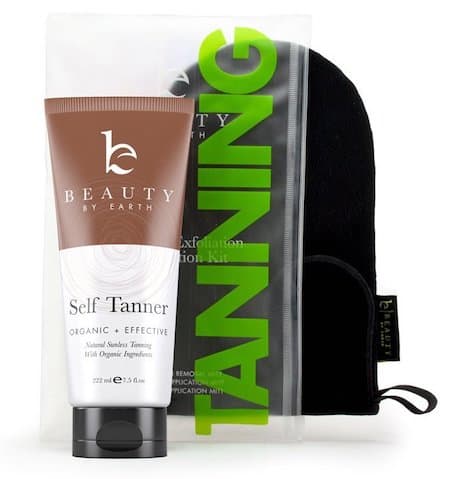
Beauty by Earth is a lotion-style option that may appeal to shoppers who prefer a more skincare-like texture.
Do not treat “natural” or “organic” positioning as meaning chemical-free. Every cosmetic formula contains chemicals, including water and plant-derived ingredients.
The formula is marketed as vegan and uses a mix of plant-derived ingredients.
The kit is convenient because it includes an exfoliating mitt, which can help with prep when used gently.
The lotion develops a bronzed look that can be built gradually with later applications as the product directions allow.
The linked listing is the Medium to Dark lotion set with body, face and exfoliating mitts. Check the current shade and bundle contents before ordering, since packaging and kits can change.
The formula may suit a range of skin types, but no self-tanner is guaranteed to work equally well for oily, dry, sensitive, fair, and deeper skin tones.
The lotion base gives you more blending time and includes moisturizing ingredients, which can be useful on legs that tend to look dry.
Not only is this my absolute favorite self-tanner for my whole body right now, but it also works extremely well for your legs! I’d encourage you to give it a try.
3. SunLabs Overnight Self-Tanning Lotion

The linked listing is the Medium 8-ounce lotion. The photo shows older packaging.
The SunLabs Overnight Self-Tanning Lotion is another traditional lotion option with a longer development style.
Its main advantage for legs is the extra blending time you get from a lotion before the color fully develops.
It is marketed as paraben-free.
With repeated use as directed, you can maintain or deepen the look gradually rather than relying on one very heavy application.
How often you reapply should depend on the label and how evenly the previous tan is fading.
On the legs, the lotion format makes it easier to work methodically over larger areas and blend around the knees and ankles.
The pump bottle is straightforward to use, and a tanning mitt can help distribute the product more consistently.
Because it is designed for longer development, it is better suited to someone who prefers applying at night rather than using a quick express formula.
4. Sally Hansen Gradual Tanning Lotion

Sally Hansen Airbrush Legs is useful when your priority is instant cosmetic coverage rather than a traditional developing self-tan.
The linked Sally Hansen product is Airbrush Legs Gradual Tanning Lotion in Light to Medium. It is a developing self-tanner, so choose it when you want to build color gradually.
For legs, spread a thin, even layer and blend lightly around knees and ankles. Follow the bottle’s directions for development and reapplication rather than expecting full color immediately.
The Airbrush Legs range also includes instant leg makeup. Check that the Amazon selection says “Gradual Tanning Lotion” before buying; the similar names cover different formulas.
5. Jergens Natural Glow Wet Skin Moisturizer

This self-tanner is an in-shower self-tanner.
Apply it to damp skin as directed, then dry off rather than treating it like a cleanser you wash away in the shower.
The color develops gradually over repeated applications, which makes it a practical option if you prefer a lower-maintenance routine.
Because it is designed for wet-skin use, it can be convenient if you do not want a separate full tanning session.
Fragrance and developing self-tan odor can vary by person, so do not expect any DHA-based product to smell identical on everyone.
Its lotion-like application makes it easy to spread over the legs while the skin is still damp.
Gradually build your color over time and stop once you reach the depth you like.
It is a convenient option if you prefer a gradual, wet-skin routine over a traditional mousse or overnight lotion.
Earlier St. Tropez Photo
The photo below shows Classic Self Tan Bronzing Lotion packaging. The current buying option above is Gradual Tan Classic in Medium/Dark.

Related Questions
Can leg self-tanners be used on the rest of the body?
Most self-tanners are not created solely for the legs. Body formulas can usually be used on other body areas if the label permits it.
A self-tanner that works well on your legs can usually be used on the rest of the body according to the product directions.
For the face, a dedicated facial formula can be easier to control because facial skin may be more sensitive and the desired depth is often lighter.
A good facial self-tanner will have great moisturizing properties to keep the face looking healthy and nourished.
Are organic self-tanners better to use?
Organic labeling does not automatically make a self-tanner safer, gentler, or more effective.
What matters more is the full formula, including fragrance, alcohol, moisturizers, preservatives, and how your skin reacts to the product.
Some organic-positioned self-tanners include oils or butters that give the formula a richer, more moisturizing feel, but conventional formulas can include the same types of conditioning ingredients.
How do you self-tan your legs?
If you are tanning only your legs, working from the top down can make it easier to blend toward the ankles and feet. When tanning your whole body, many people prefer to start lower so bending does not disturb wet product already applied to the torso.
The most important point is to avoid rubbing freshly applied product against other areas while you work.
Choose whichever order lets you move comfortably without creasing, smearing, or transferring wet self-tanner.
Can I use a spray self-tanner on my legs?
Self-tanner spray can be used on the legs, but feet and ankles usually need extra blending because they are drier and more textured.
Instead of spraying heavily between the toes or over the heels, use a light amount and blend carefully with a mitt or brush.
A spray can work well, but lotion or mousse may be easier for beginners because you can see and feel where you are blending.
The Best Self-Tanners for Legs
A well-applied self-tanner can give your legs a smoother, more even-looking bronze finish without suggesting that cosmetic color changes your actual muscle tone or shape.
The best results come from careful prep, light application on dry areas, and choosing a formula you can blend confidently.
I hope you enjoyed this article. If you did, please consider sharing it!
Your friend,
Kate
Related Articles
How Much Does Self Tanner Cost? – 11 Examples


