

How Does Fake Tan Work? – Complete Guide
Fake tan offers a great solution for developing a dark tan, without having to set foot in the sun and risking damage caused by UV rays.
Using a fake tan is a safer option than lying out in the sun or in a tanning bed, and it gives skin a bronzed glow that lasts for up to two weeks.
Self-tanner might be the right option for you, but how does it work?
Self-tanners work through an active ingredient called dihydroxyacetone (DHA). This chemical compound reacts with skin cells to stain the skin, causing a tan to develop. The more DHA a fake tan product contains, the darker the skin will become.

Understanding how fake tan works will help you better decide if it is the right product for you, and it will help you know how to use it properly, getting the most gorgeous tan possible.
How Fake Tans Work To Tan Skin
Both self-tanning home products and spray tans use DHA, which creates the appearance of tanned skin.
Dihydroxyacetone, also known as DHA, is a simple carbohydrate that can be sourced either chemically or naturally, from natural products such as beets and cane sugar.
The DHA reacts with the amino acid in the top layer of your skin and oxygen in the air, generating pigments called melanoidins that cause the skin to appear brown as they absorb certain wavelengths of light.
This process is called the Maillard reaction. It usually only starts around two to four hours after the fake tan product has been applied, and can continue for up to 72 hours.
Only the outer dead skin cells are affected by this reaction, meaning the tan will begin to fade as the skin cells naturally fall away.
Regardless of the product you use, you will notice a distinctive self-tanning scent during the process, which is due to the chemical reaction.
All DHA-containing products will emit this smell, but some fake tanning products contain fragrances that help mask the odor.
Is Fake Tan Safe?
The issues with fake tans are due to DHA, which causes a chemical reaction with the skin.
To put it simply, the same chemical reaction, the Maillard reaction, which darkens the skin, is the same that happens when you caramelize sugar or grill meat.
While there is no sun involved, you are still essentially grilling your skin.
Here is what happens when you apply fake tanners containing DHA to your skin:
- Oxidative stress – The reaction of DHA creates free radicals, which can lead to oxidative stress. Free radicals can attack cell structures, degrading elastin fibers and collagen, which can lead to premature aging, sagging skin, and wrinkles.
- Sun damage – The oxidative stress can be intensified if you go out into the sun after applying a fake tan, as UV rays make DHA more unstable. This means that more free radicals are created when there is exposure to the sun, resulting in more damage to the skin.
- Vitamin D deficiency – Regular use of fake tanners may decrease your vitamin D content. The melanoidin pigments, which are created by DHA, might inhibit vitamin D production in the body.
- Irritation – DHA and other ingredients found in fake tanners can cause irritation to the skin. Many fake tans contain fragrances to mask the smell of self-tanner, and this is one of the main causes of skin irritation associated with fake tanners. Many fake tanners can also clog pores, which leads to breakouts.
How To Lessen The Effects of DHA
There are some ways to lessen the damaging effects of DHA, making it a safer option than sitting out and tanning in the sun.

Here is how you can limit the damage from DHA:
- You can limit the damage by protecting your skin from the sun. UV rays amplify the production of free radicals, so by simply avoiding the sun, you can reduce the free radicals created. If you cannot avoid stepping into the sun, you should apply strong sunscreen, such as SPF 50, routinely to further protect your skin.
- You can use an antioxidant on your skin, such as vitamin C in the form of L-ascorbic acid, which is a powerful antioxidant. There are also sunscreens that contain ascorbic acid, which protects your skin from sun damage and the free radicals it forms.
- One of the simplest ways to minimize damage is to use self-tanner less frequently, saving it for special occasions rather than applying it multiple times a week.
Watch this quick video by BytesizeScience on YouTube for a summary of how fake tans work.
Are There DHA-Free Fake Tans?
There are now newer fake tan products on the market that are labeled as DHA-free. These are supposed to be gentler and safer alternatives to fake tanning products that contain DHA.
They are said to work by containing a purified keto-sugar that reacts with the amino acids in the skin, producing a golden tone within 3 days, without any of the negative side effects associated with DHA.
While this sounds ideal, one needs to take a closer look at the ingredients to determine whether it is a better option or not.
DHA-free fake tanning products contain erythrulose, which is essentially the same thing as DHA.
Erythrulose is found naturally in red raspberries and is very similar in composition to DHA. Applied on its own, erythrulose does take longer to produce a darker tan, and this tan does fade quickly.
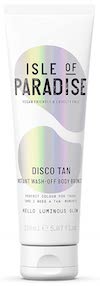
My absolute favorite DHA-free body bronzer is this one by the Isle of Paradise.
This ingredient also causes a tan that is more red than brown. However, when combined with DHA, the tan created lasts longer, fades more evenly, and gives a better tone.
Erythrulose also causes an increase in the production of free radicals, much like DHA, so they aren’t that much safer.
Caring For A Fake Tan
It is important to remember that you need to practice some aftercare once you have applied your fake tan.
Remember that DHA only penetrates the outermost layer of the skin, which is primarily composed of dead skin cells.
This is why fake tans don’t last longer than a week, as that is the usual time frame it takes for these dead skin cells to slough off.
It doesn’t matter how long the fake tan product claims to last; you cannot stop the natural processes of the skin.
For this reason, it is important to exfoliate the skin well before applying a fake tan.
This removes any excess dead skin cells so that the DHA does not stain these built-up skin cells, which could result in a blotchy tan.
Once you have applied the fake tan, avoid getting your skin wet for a few hours. Uneven moisture will affect how the reaction occurs and could result in a streaky and patchy tan.
To keep the tan as even as possible, you should exfoliate very lightly a few days after the tan. The skin cells could build up, and this could begin to flake off in patches, causing an uneven tan.
The most important part of aftercare is to keep your skin moisturized.
This will help your tan last longer and prevent the DHA from drying out your skin. Moisturized skin not only holds a tan better but also allows it to fade more evenly.
Related Questions
Is a self-tanner safer than a spray tan?
While a spray tan might be easier for some, as it involves a professional applying the formula to your skin, which reduces the chance of the tan being patchy and streaky, it is not necessarily the safest option.
DHA on the skin from a self-tanner is one thing, but as the formula is being sprayed on your body, you will end up inhaling some of it as well.
There is no telling what excessive inhalation of DHA might do to your body, but you can choose to wear a protective mask to try to mitigate this effect.
Can you still tan while wearing a fake tan?
Fake tan does not protect your skin from sun damage at all. Some fake tanning products claim to have SPF protection, but like other sunscreens, this will fade within a few hours.
You can still tan and burn through a fake tan, so it’s essential to protect your skin by applying a broad-spectrum sunscreen when going out into the sun.
Final Thoughts
Understanding how fake tanners work will enable you to determine if they are the right product for you and how to further protect your skin when using one.
Fake tanning products are a great alternative to sitting out in the sun and damaging your skin, and most can be used at home.
However, just because they are safer than sun tanning, it does not mean that they are completely safe.
The active ingredient in fake tanners, DHA, can cause some damage to the skin.
Therefore, being aware of the chemical reaction and knowing how to protect your skin from any damage can help you make the most of fake tan products while still ensuring your skin remains healthy.
Related Articles
How To Make Fake Tan Darker – The Essential Guide


